
NOTES FROM THE FIELD

Code Update #1: Dual Banded Tendon Layout: A Major Advancement in PT Design
Learn how the ACI-PTI 320-25 Code introduces dual banded tendon layouts, improving constructability, flexibility, and long-term value in PT slabs.
5 Changes You Need to Know About the New ACI-PTI 320-25 Code
by Chair, Don Kline, PE
The ACI-PTI 320-25 Code is the first standalone building code dedicated exclusively to post-tensioned concrete, and it introduces some of the most impactful changes to PT design in over 50 years.
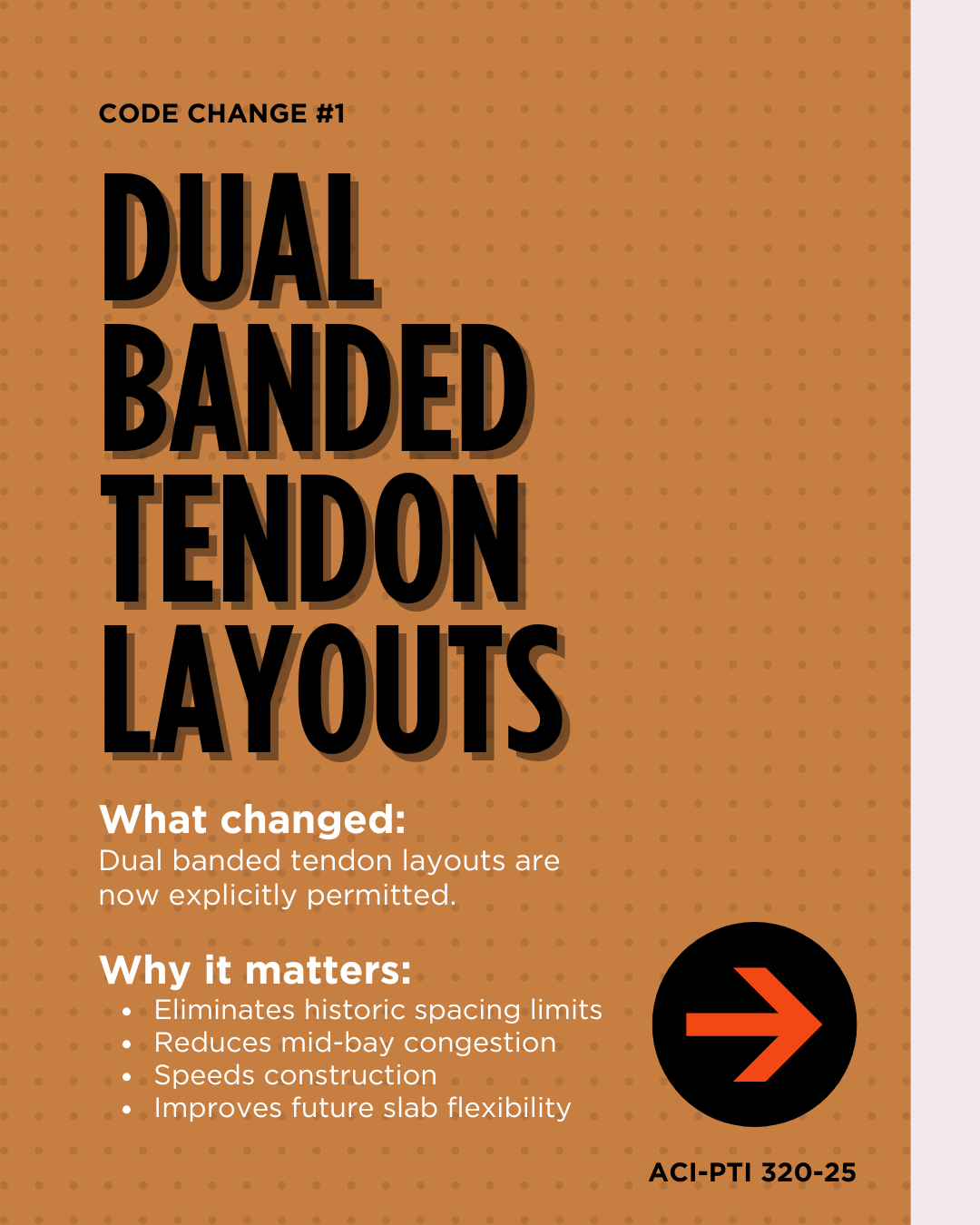
The ACI-PTI 320-25 Code introduces dual banded tendon layouts as a permitted design approach for two-way post-tensioned slabs, representing the most significant advancement in post-tensioned slab design in more than 50 years.
Historically, post-tensioned slab systems relied on banded-distributed tendon layouts, with prescriptive spacing limits that often constrained design flexibility and constructability. The new code provision allows engineers to adopt dual-banded (banded-banded) tendon layouts, providing greater freedom in tendon arrangement while maintaining structural performance.
Research and Validation
This code change is supported by full-scale experimental testing and analytical studies, including a comprehensive research program conducted in collaboration with Virginia Tech. Comparative testing of slabs with banded-distributed and dual-banded tendon layouts demonstrated equivalent performance in strength, deflection, cracking behavior, and serviceability. Analytical studies further confirmed that slab behavior is governed primarily by the total prestressing force rather than by tendon distribution.
Test results showed:
Comparable flexural capacity and load-carrying behavior
Similar short- and long-term deflections
Equivalent crack control at service load levels
Equal or improved punching shear performance at columns
These findings validated that concentrating tendons at column strips does not compromise slab performance when overall prestress and reinforcement requirements are met.
Design and Constructability Benefits
By eliminating historic spacing limits on distributed tendons, the new provision offers significant practical advantages:
Reduced reinforcement congestion in mid-bay slab regions
Simplified tendon placement and reduced field conflicts
Faster installation and improved constructability
Greater flexibility for future slab penetrations
Improved adaptability for tenant turnover and evolving building use
Dual-banded layouts are especially beneficial for buildings with complex MEP coordination, frequent future modifications, or specialized slab systems, such as waffle or voided slabs. From an owner and lifecycle perspective, post-tensioned systems are more adaptable for buildings with evolving layouts, such as offices, hospitals, laboratories, residential, and retail developments.
What This Means for Engineers and Owners
The inclusion of dual banded tendon layouts in ACI-PTI 320-25 reflects a research-driven evolution of PT design, preserving the structural advantages of post-tensioning while expanding its constructability and long-term value. Engineers now have greater flexibility to optimize tendon layouts based on performance, construction efficiency, and lifecycle considerations, without sacrificing safety or serviceability.